
By Dr Eranga Jayasekara
Small and Medium-sized enterprises in Sri Lanka have long been the silent engine of Sri Lanka’s economy, supporting community in both rural and urban areas, creating jobs and encouraging innovation. In the time of stability, they are the foundation of development. In the time of crisis, they form the first line of defense. In the context of navigating economic recovery, global uncertainty, and rapid technological advancements, SMEs are at a pivotal juncture. While they continue to grow, adapt, and innovate, they also encounter a myriad of challenges that test their resilience and strategic direction.
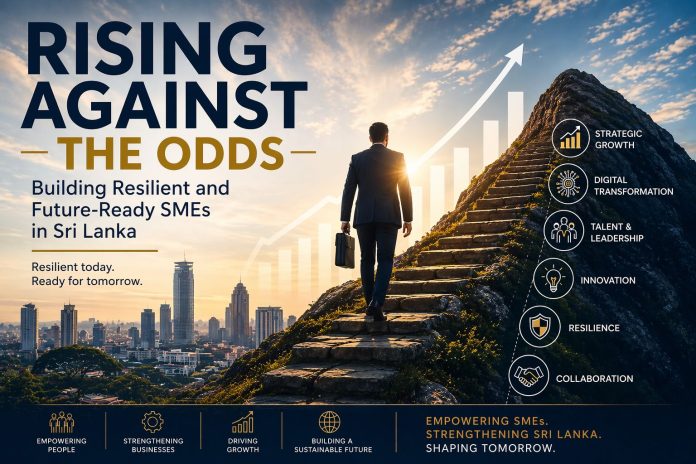
However, these difficulties present significant opportunities. The narrative surrounding Sri Lankan SMEs has shifted from one of mere survival to one of transformation, emphasizing the need to rethink business models, redefine leadership, and reconstruct enterprises that are both resilient and prepared for the future.
The Growth Paradox: Expansion Amidst Constraints
Sri Lankan SMEs are currently exhibiting an excellent development potential. Many have broadened their offerings, embraced digital technologies, and entered new industries. Nevertheless, this expansion frequently takes place in a restricted setting marked by limited resources, unpredictable economic situations and structural inefficiencies.
This paradox – growth despite limitations – creates a unique kind of tension. Companies want to grow, but they often can’t because of problems with operations, inconsistent policy support, and a lack of access to reliable market information. Because of this, growth is not always planned; it is sometimes reactive. When small and medium-sized businesses see chances to grow, they do so. But without a clear long-term plan, their future is uncertain.
To address this challenge, SMEs must transition from opportunistic growth toward strategic scaling. This entails careful planning, reliance on data for decision-making, and the establishment of clear long-term objectives. Enhancing internal competencies, especially in financial planning, market analysis, and operations management, is crucial for converting short-term successes into lasting, sustainable achievements.
Financial Fragility and the Credit Access Dilemma
Access to finance has become one of the most persistent challenges for Sri Lankan SMEs. Most of the SMEs find it difficult to obtain timely and reasonably priced loans, despite their vital role in the economy. Significant barriers are created by high interest rates, strict collateral requirement and complex lending processes.
Financial fragility can significantly hinder SMEs, impacting their daily operations and stifling long-term growth opportunities in innovation and technology. Many of these businesses find themselves caught in a cycle where cash flow issues limit progress, which in turn restricts their financial capabilities.
To break free from this cycle, a two-pronged strategy is essential. Policymakers and financial institutions need to offer more inclusive financing options, like credit guarantee schemes and flexible lending tailored for SMEs. At the same time, these businesses should reinforce financial discipline through transparent accounting, thorough documentation, and building financial literacy. These practices are crucial for sustainable growth.
Digital Transformation: From Optional to Essential
The digital revolution is changing businesses all over the world, and Sri Lanka is no different. Digital transformation is no longer a luxury for SMEs; it is necessary for them to stay alive and competitive.
But the path to digitalization is not smooth. Some SMEs have successfully adopted e-commerce, digital marketing, and cloud-based systems. However, many others are still behind because they don’t know much about technology, the costs of implementation are high, and they don’t want to change. The digital divide is increasingly widening the gap between innovative enterprises and those that find themselves unable to keep pace with technological advancements.
SMEs are encouraged to begin with modest initiatives while aspiring to broader goals, utilizing cost-effective tools like social media, online marketplaces, and basic data analytics to improve customer engagement and operational efficiency. Collaborating with technology providers, educational institutions, and industry networks can further expedite this vital transition.
Ultimately, the objective transcends mere technological adoption; it centers on the strategic integration of these tools into the very fabric of the business.
Talent Challenges and Leadership Gaps
Behind every successful SME there is a capable and committed workforce. Yet, attracting and retaining talent remains a significant challenge. Most of the skilled employees in Sri Lanka often gravitate toward larger organizations or seek opportunities abroad, leaving SMEs with a limited talent pool.
Simultaneously, many leaders in SMEs are confronting the challenges posed by contemporary leadership demands. The traditional entrepreneurial mindset, characterized by control and intuition, is under increasing pressure in an environment that necessitates agility, collaboration, and strategic thinking.
Consequently, there is a significant leadership gap. To develop future-ready organizations, SME leaders must transform into adaptive leaders capable of navigating uncertainty, inspiring teams, and making informed decisions amidst complexity.
Key tactics to deal with this issue include empowering staff, encouraging a culture of ongoing learning, and investing in leadership development. SMEs that prioritize people – not just processes – will be better equipped to innovate and grow sustainably.
Innovation as a Strategic Imperative
It is a popular belief that large corporations with enormous resources are the only ones capable of innovation. But innovation is a strategic necessity for SMEs – not only an option. In today’s swiftly evolving business landscape, the capacity for innovation is crucial for long-term sustainability. This need not solely involves the creation of cutting-edge technologies; innovation can manifest in various ways, such as optimizing processes, enhancing customer experiences, or developing novel business models.
Sri Lankan SMEs possess a distinct advantage in this context. Their relatively small size facilitates greater flexibility and quicker decision-making. By cultivating a culture that encourages creativity and experimentation, SMEs can transform challenges into opportunities.
Furthermore, collaboration plays a vital role. Partnerships with universities, research institutions, and other enterprises can yield valuable insights, resources, and innovative ideas, highlighting that innovation flourishes within interconnected ecosystems rather than in isolation.
Building Resilience: The Way Forward
Resilience is no longer a reactive trait – it is a strategic capability. For Sri Lankan SMEs, being resilient means being ready for uncertainty, adapting to change and emerging stronger from challenges.
This requires holistic approach. Financial resilience, operational efficiency, digital readiness, and human capital development must all be integrated into a cohesive strategy. Resilient SMEs do not avoid problems, instead, they learn, change, and grow all the time.
The role of mentality is equally significant. Believing in possibilities, being open to change, and being dedicated to long-term development are the foundations of resilience. In this way, resilience is as much about strategy as it is about leadership.
A Call to Action: Shaping the Future of Sri Lankan SMEs
The journey of Sri Lankan SMEs is far from easy, yet they have a promising future ahead them. The opportunities that lie ahead are just as real and significant as the obstacles they face.
This moment calls for innovative thinking and decisive action. Leaders SMEs must transcend short-term strategies focused solely on survival and adopt a vision geared towards sustainable growth. Policymakers are urged to foster an environment conducive to innovation and inclusivity, while financial institutions need to reevaluate their strategies for SME financing. Furthermore, as a nation, we must acknowledge and celebrate the essential contributions of SMEs to our economic and social systems.
The trajectory of Sri Lanka’s economy will be influenced not only by large corporations and policy reforms but also by the collective strength and resilience of its SMEs. By overcoming challenges and embracing transformation, these enterprises can emerge as significant catalysts for progress, cultivating a more dynamic, inclusive, and prosperous future for all.
Ultimately, the story of Sri Lankan SMEs is not just about business. It is about courage, creativity, and the relentless pursuit of possibility. And that is a story worth telling – and worth investing in.
The writer is a Senior Lecturer in the Department of Science for Technology, Faculty of Technology, University of Sri Jayewardenepura.
