
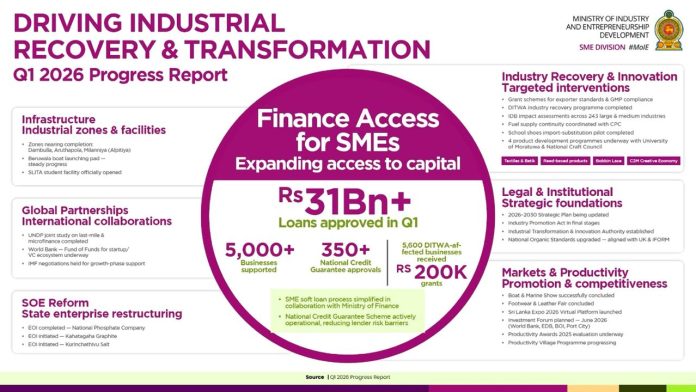
Sri Lanka’s industrial sector recorded a strong start to 2026, reflecting renewed momentum under a reform-driven agenda aimed at fostering private sector-led growth. Progress during the first quarter underscores a strategic shift from economic stabilisation towards structured industrial expansion.
Key infrastructure initiatives gained traction, with industrial zones in Dambulla, Aruthapola, and Milanniya nearing completion, while developments such as the Beruwala boat launching pad continued to advance. Investment in human capital also remained a priority, supported by ongoing initiatives through SLITA.
On the policy front, authorities accelerated the implementation of a comprehensive framework, including the Export Development Strategy, the proposed Industrial Development Act, National Tariff Policy, and anti-dumping measures. Institutional strengthening was further reinforced through the introduction of the SME Framework, National Business Registry, and Incubator Framework.
Access to finance saw a notable expansion, with over Rs. 31 billion in loans extended to more than 5,000 SMEs. The operationalisation of the Credit Guarantee Scheme and targeted grants for affected enterprises enhanced financial inclusion and reduced lending risks.
International collaborations with organisations such as UNDP, the World Bank, and the IMF continued to support investment readiness and financing innovation. Meanwhile, ongoing State-Owned Enterprise reforms are expected to improve efficiency and unlock long-term value.
Overall, Q1 2026 signals a decisive move towards competitiveness, export growth, and job creation within Sri Lanka’s industrial landscape.
