
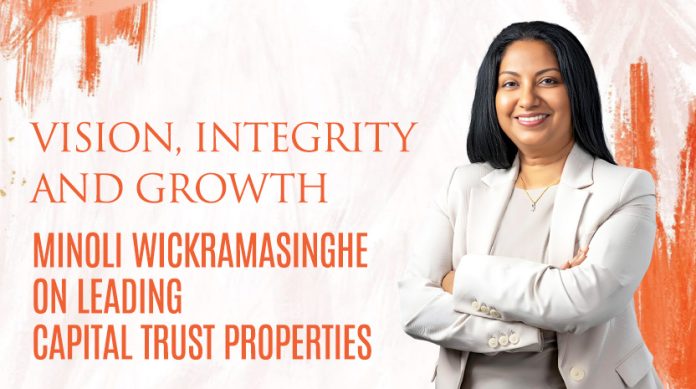
Minoli Wickramasinghe’s journey from DFCC Bank’s youngest trainee to the helm of Capital Trust Properties is one of vision, integrity, and resilience. Having gained global exposure and corporate expertise, she founded Capital Trust Properties in 2010 with just two employees.
Today, it stands as Sri Lanka’s leading real estate advisory, trusted by corporates and developers for its ethical practices, due diligence, and deep market insight. Global CEO Magazine recently had the opportunity to talk with her, where she reflected on building a brand rooted in professionalism, nurturing stakeholder trust, and preparing for the evolving dynamics of Sri Lanka’s real estate sector.
Capital Trust Properties has built a reputation as one of Sri Lanka’s leading real estate service providers. What has been the guiding philosophy behind creating a brand trusted by thousands of Sri Lankans?
Capital Trust Properties, a company I founded with a humble beginning in 2010 with only one other employee, has today become a leading real estate brand, built on years of professionalism, ethics, and expert knowledge of the industry. We are now a fully fledged real estate company that offers services ranging from legal advice, interior solutions, real estate transaction services, valuations, property management, and market research. We have become a recognised voice of real estate in Sri Lanka, trusted by the biggest corporates and developers who rely on our advice. We also conduct strict due diligence when taking developers and projects on board. Completion, quality of construction, and the morals and ethics of the developer are very important when we market any development.
Your company is recognised for ethical practices, personalised service, and expert market knowledge. How do you ensure these values are consistently upheld across your team and client engagements?
We are recognised for our ethical practices, as this has been an integral part of our day-to-day operations and forms a central part of our overall strategy. Without ethics and integrity, we believe there is no sustainability. We ensure these values are embedded in all our systems and human resource practices. Non-adherence amounts to immediate removal from the organisation.
With over a decade of experience in the industry, what trends do you see shaping Sri Lanka’s real estate market in the next five years, and how is Capital Trust Properties preparing for them?
Capital Trust Properties, established in 2010, was a pioneering real estate transaction company formed due to the absence of a professional advisory firm to help acquire a portfolio of assets. After the war, we decided this was the best sector to enter. At the time, this asset class was not considered by investors to be a real investment. Coming from an international environment, I found real estate prices in Sri Lanka extremely cheap compared to other countries and saw the future growth potential. This was one of the best decisions our group made—buying real estate at the right time.
We operated like a regulated entity, with ethics and professionalism. We also seized opportunities that others overlooked and helped all our stakeholders in the process. A key to our success has been looking after stakeholders’ interests—our customers (corporates and individuals), developers, and government bodies. Our philosophy is that if they do well, we will succeed too, and this approach has always served us well.
This was particularly evident when COVID-19 hit. Capital Trust Properties conducted significant research on its impact and concluded that a currency crisis would affect developers who had marked their rentals, particularly commercial properties, in LKR. We advised developers to standardise and adhere to dollar pricing. Many renowned developers of commercial spaces acted swiftly on our advice.
We also initiated new bundled products for developers, who adapted to these ideas and reaped the benefits. Certain services we provided did not yield us direct financial gain, but we knew they would benefit our stakeholders, and we were prepared to offer them as complimentary services. Our relationships with stakeholders often go beyond financial benefit—they are built on solid trust, integrity, and professionalism.
For example, commercial spaces in Sri Lanka had only 30% occupancy in 2021 due to COVID and remote working, but are now about 90% to 100% occupied. The benefit we created had a trickle-down effect for all stakeholders and the industry alike. Similarly, luxury apartment rentals that stood at 4% in 2021 have now reached around 7%, as we helped absorption rates move closer to all-time highs.
Having lived abroad and seen comparisons with Sri Lanka’s real estate industry, I believe that with consistent policies, low interest rates, improved ease of doing business, and a more open economy with fewer restrictions, Sri Lanka’s real estate sector will prosper by 2026. However, many reforms are necessary for this to happen and to remove uncertainties in the minds of foreign institutional and individual investors.
