
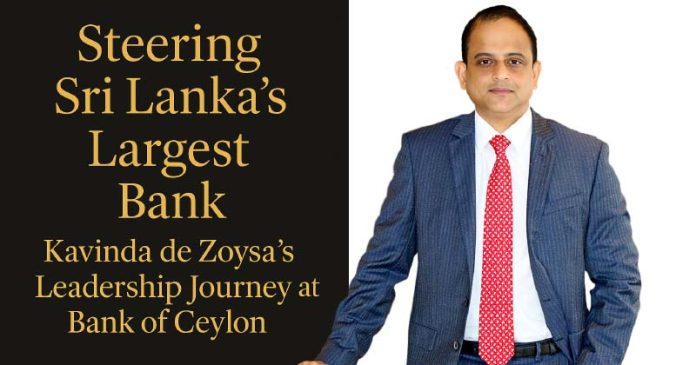
Global CEO Magazine is delighted to present an exclusive conversation with Mr Kavinda de Zoysa, Chairman of Bank of Ceylon and Chairman of BOC (UK). With more than three decades of experience across the banking and financial sector, Mr de Zoysa shares the milestones of his journey, insights on leadership, and his vision for steering Sri Lanka’s largest commercial bank through times of transformation.
As Chairman of the Bank of Ceylon (BOC), he leads Sri Lanka’s largest commercial bank, an institution that has been “Bankers to the Nation” for more than 85 years. With over 660 branches and 2,200 touchpoints across the island, BOC also extends its presence to the Maldives, India, Seychelles, and through its fully owned subsidiary in the United Kingdom. Under his stewardship, the Bank continues to champion financial inclusion, national development, and service excellence.
Mr de Zoysa brings unmatched expertise, with a career covering corporate and investment banking, capital markets, mergers and acquisitions, project financing, SME lending, and digitisation. Before taking on his current role, he served as Director and Country Business Head of Citibank N.A. Sri Lanka, and was also instrumental in the formation of a new commercial bank with international and local partners, as well as the merger of a local and foreign bank—both of which today stand among the country’s leading institutions.
He holds an MBA with Merit from the University of Colombo, where he was awarded the Gold Medal, and is a Fellow of CIMA (U.K.), CIM (U.K.), the Institute of Bankers of Sri Lanka, and the Institute of Certified Management Accountants of Sri Lanka. Beyond his corporate achievements, he serves the industry through pro bono work as a Global Council Member of CIMA (U.K.), mentor, and lecturer, reflecting his commitment to nurturing future leaders.
You have had a career spanning over 30 years in the banking and financial sector. Could you walk us through some of your key milestones that shaped you into the leader you are today?
I began my career at the age of 18, immediately after my A Levels. From the very beginning, I invested in education while working in banking, which gave me a solid grounding in trade finance, bills of exchange, and the fundamentals of the profession. That combination of education and practical application accelerated my career growth.
My journey has always been about continuous learning. I pursued banking qualifications, CIM, CIMA, and eventually my MBA at the University of Colombo. Each stage gave me a different perspective—whether it was marketing, management accounting, or strategy—and this balanced knowledge enabled me to approach challenges with confidence.
I must also acknowledge the support of my family, particularly my wife Nishani, who encouraged me to focus on education, and my son, who stood by me through both good and difficult times.
As Chairman of the largest bank in Sri Lanka, how do you see your role in navigating Bank of Ceylon through such a complex and transformative period?
I take this role with deep responsibility and humility. Bank of Ceylon is systemically important to Sri Lanka’s economy. We faced many challenges—the Easter Sunday tragedy, the pandemic, and the economic crisis—but from that point there was nowhere to fall, only the way up.
The last 18 months have been a period of recovery, where we have focused on digitisation, financial inclusion, responsible lending, and governance. The bank has emerged as the most profitable institution while continuing to play a pivotal role in supporting SMEs, development banking, and national recovery. Our role is not only to ensure profitability but to build a future-ready institution through investments in technology, people, and sound governance.
How is Bank of Ceylon deepening its impact on Sri Lanka’s national development?
Bank of Ceylon has been at the forefront of development banking and financial inclusion. A prime example is our leadership in the Aswasuma programme, where we opened accounts for thousands who had never entered the banking system before and provided them with debit cards to take their first step into digital finance.
Beyond lending, we are instilling savings habits among citizens, even those in vulnerable segments. We are also strongly engaged in SME financing, revival of struggling businesses, and supporting industries focused on import substitution. These initiatives directly contribute to strengthening the national economy and preserving foreign exchange.
Your background includes experience in investment banking, capital markets, and mergers and acquisitions. How does this shape your leadership at BOC?
I believe in surrounding myself with capable teams. At BOC, we are fortunate to have a highly skilled management team that makes collaboration easier. My role is to encourage original thinking, strong ethics, and adherence to governance.
I also bring global perspectives from my work with international bodies such as CIMA in the UK, and through my role as Chairman of BOC UK, where the bank is regulated by the Bank of England. This exposure to global best practices enriches our ability to adapt and innovate locally. Importantly, I encourage listening— some of the best ideas often come from staff at outstation branches, and as a leader it is my role to give them the platform to be heard.
What are some of the biggest challenges BOC is currently facing, and how do you plan to address them?
Navigating economic uncertainty is the foremost challenge. External factors, from international trade policies to domestic weather patterns, can significantly affect the economy. We are addressing this by investing in technology, strengthening risk management systems, and maintaining transparency and governance.
Equally important is stakeholder engagement—whether it is our workforce, unions, regulators, or shareholders. Balancing these perspectives is critical for long-term sustainability.
How would you describe your leadership style and the core values that guide you?
My leadership style is collaborative and grounded in responsibility. I believe in collective ownership— when things go well, credit should be given to the team; when challenges arise, we as leaders must take responsibility.
I am deeply committed to ethics, corporate governance, and nurturing talent. Identifying and grooming individuals early has been very rewarding. I also value teamwork over individual brilliance, because sustainable success is built on collective excellence.
What is your perspective on continuous learning?
Continuous learning is something I am passionate about. Throughout my career I have pursued new studies every decade—whether in banking, management, accounting, or data-driven decision-making. Recently, I completed a programme at the University of Chicago Booth Business School on data-driven decision-making, which gave me a fresh set of skills highly relevant to today’s environment.
Learning keeps us future-ready. If we ever think we know everything, that is the beginning of decline. For me, investing in myself has always been a priority, and I encourage young professionals to keep their hunger for knowledge alive.
In your view, what are the biggest opportunities ahead for Sri Lankan banks?
Digitisation is the foremost opportunity, as the integration of banking with the digital ecosystem is still at an early stage. Beyond that, there is immense potential in SME financing, microfinance outside the main provinces, and development banking.
We are also seeing new opportunities in ESG financing and capital market development. At a broader level, sector consolidation may also play a role in shaping the future of banking in Sri Lanka.
Finally, what advice would you give to young professionals aspiring to build successful careers in banking and finance?
My foremost advice is to stay hungry and keep investing in yourself. Read widely, take part in global forums, and acquire new skills. Do not rely on shortcuts—patience, ethics, and perseverance are what sustain success.
Be willing to step out of your comfort zone. At the peak of my career in an international bank, I made the decision to move, because I believed in gaining broader knowledge and experience. Leaders must also remain optimistic, genuine, and focused on building the next generation of leaders.
Sri Lanka needs leaders who are committed to ethics and innovation. To young professionals, I say: believe in yourself, keep learning, and be ready for the future.
