
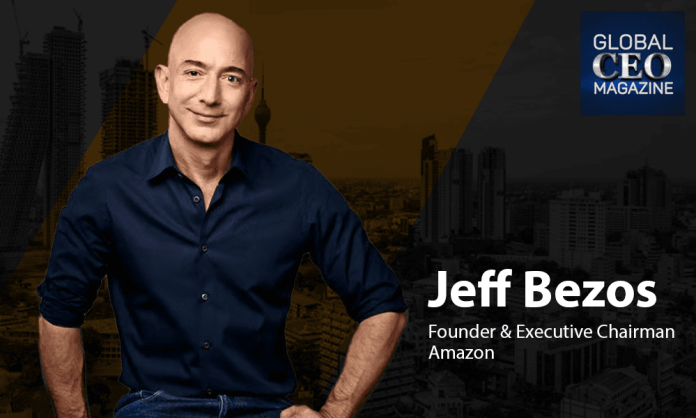
At the 2024 New York Times DealBook Summit, Jeff Bezos sat down with Andrew Ross Sorkin—founder and editor-at-large of DealBook—for a rare and revealing conversation.
As the founder and Executive Chairman of Amazon, and the visionary behind aerospace company Blue Origin, Bezos offered a wide-ranging perspective on what lies ahead for his companies and, indeed, for humanity.
From the evolution of artificial intelligence and the future of Amazon, to the long-term vision of space exploration and the preservation of Earth, this conversation revealed the inner workings of a leader whose ambitions continue to expand far beyond the horizon.
What emerged was not simply a discussion about commerce or technology, but a window into the mind of a man reshaping the world through audacious thinking and strategic patience. With equal parts pragmatism and optimism, Bezos offered insights into his leadership style, business philosophy, and enduring belief in innovation as a force for good. Whether grounded in the data centres of Amazon or orbiting among the stars with Blue Origin, Jeff Bezos remains one of the most influential architects of our shared future.
Bezos’s leadership style is rooted in relentless curiosity and a willingness to embrace the messy process of innovation. Inside Amazon, he fostered a culture where truth trumps presentation.
In meetings, teams are discouraged from glossy, rehearsed pitches – Bezos would rather see honest debate, even if it’s disorganised. “Internally, you’re seeking truth, not a pitch,” he says, preferring discussions to be unvarnished and authentic.
He even asks if there are dissenting opinions in the room and insists that junior team members speak before senior ones. By voicing his own views last, he avoids stifling the candour that he believes leads to the best ideas. This approach reflects a Day-One mentality that values learning and adaptation over hierarchy.
Despite having strong convictions, Bezos prides himself on being open-minded. “I change my mind a lot,” he admits, noting that he is “very easy to influence” when presented with new information . Yet on the rare occasions he is absolutely sure about a vision, he will pursue it with unwavering resolve – “through sheer force of will if need be”.
The launch of Amazon’s third-party Fulfilment service was one such gamble he refused to be talked out of, and it ultimately became a cornerstone of Amazon’s success.
Crucially, Bezos believes optimism is a contagion every leader should spread. Enthusiasm and positivity, he argues, are essential for inspiring teams through tough times. “Without optimism and energy, I don’t know how some glum Eeyore-type founder could ever lead a company to success,” he reflects.
For years, Bezos embodied the upbeat, “it’s always Day 1” ethos at Amazon – rallying his employees with big dreams and a laugh that became legendary in conference rooms. But experience has also taught him the value of vulnerability.
In recent years, he has grown comfortable admitting when he’s worried or unsure. “I’ll have a meeting… and when it’s my turn to talk, I’ll say, ‘I’m scared,’” he shares, explaining that openly acknowledging fears invites the team to solve problems together. It’s a surprising phrase from a CEO, yet Bezos found that honesty builds trust and helps pinpoint issues more precisely than if he only showed anger or impatience. This balance of optimism and transparency has made Bezos’s leadership distinctive – he can be both the chief cheerleader and the one sounding the alarm, as context requires.
Another hallmark of Bezos’s leadership is his focus on the long game. From early on, he planned Amazon in a way that it could thrive without him. “Even when Amazon was a tiny company, I wanted to build a company that would outlast me,” he says.
Instead of becoming a “genius with a thousand helpers,” Bezos chose to empower strong deputies and build a self-sustaining culture. He often likens this to parenting: you raise a child to be independent, and if they still need you for everything, “you’ve failed” .
At Amazon he preached that “no one is indispensable,” including himself. This ethos ensured that when he stepped down as CEO in 2021, the company was prepared to carry on under new leadership.
“Big leaders only have to do a few things,” Bezos says. Identify the big ideas, drive execution on those ideas, and cultivate the next generation of leaders.
By focusing on those priorities – and instilling them in his team– Bezos created an organisation that continues to innovate even in his semi-retirement.
Today, as Executive Chairman, he remains a guiding presence (“my heart and curiosity are in Amazon” he says) but he empowers CEO Andy Jassy to steer the ship day-to-day. It’s the natural evolution of a leadership style built on trust, high standards and long-range vision.
Long-Term Strategy: Betting Big at Amazon and Beyond
Throughout his career, Jeff Bezos has demonstrated a knack for betting big on the future. His strategic playbook has always favoured boldness over caution. “I think it’s human nature to overestimate risk and underestimate opportunity,” he observes – a bias he consciously set out to correct . This meant being willing to take risks that others thought crazy.
When Bezos started Amazon in 1994, few understood the internet’s potential. He famously left a secure Wall Street job to sell books online, armed with what he called a “regret minimisation framework” – essentially, the desire to avoid the regret of not seizing the internet opportunity. In that first chapter, Bezos accepted the high likelihood of failure. Pitching Amazon to 60 potential investors, he told them there was a 70% chance they would lose their money . (In retrospect, he quips, even that might have been optimistic). About 38 investors walked away, but the ones who believed in his vision helped fund what would become a retail revolution.
Bezos recalls that period as “the hardest thing I’ve ever done,” with many skeptical questions like “What’s the internet?”. His willingness to endure rejection stemmed from a conviction that thinking small was a self-fulfilling prophecy. Instead, he thought big – envisioning Amazon not just as an online bookstore, but as an everything-store that could leverage technology to redefine customer convenience.
That bet paid off. Amazon grew from a scrappy online retailer into one of the world’s most valuable companies, in part because Bezos kept widening the lens of opportunity. A pivotal strategic leap came with Amazon Web Services (AWS).
The idea for AWS, now a cloud-computing behemoth, was sparked when Bezos noticed an old brewery in Luxembourg had its own electric generator on display. In the early 20th century, before public grids, “everybody did” – each factory or hotel had to generate its own power .
Computing in the early 2000s looked similar, with every company running its own servers. “That’s not going to last,” Bezos realised. “You’re going to buy compute off the grid. That’s AWS” . It was a classic Bezos move: spot a fundamental technology that could be offered as a utility, invest ahead of the curve, and scale it ferociously. AWS went from an internal experiment to a backbone of the internet, illustrating how Bezos’s strategic vision often transcended Amazon’s original e-commerce mission.
Now, Bezos is helping Amazon place its next big bet: artificial intelligence. Although he stepped back from daily management, he has thrown himself into the company’s AI initiatives. “I work from about nine to seven in meetings… and right now it’s 95% AI,” he says of his current schedule .
He sees AI as a transformational general-purpose technology – a “horizontal enabling layer” that “can be used to improve everything” and “will be in everything” . In the interview, Bezos even analogised modern AI to electricity in its ubiquity and power. Just as electricity revolutionised every industry, AI is poised to do the same – becoming as common and necessary as the electric grid.
To keep Amazon at the forefront, the company has been investing heavily in AI across all its businesses, from retail logistics to cloud services. This year Amazon unveiled “NOVA,” its own large language model, which Bezos touts as a “world-class” AI model that benchmarks extraordinarily well. He insists it is “absolutely competitive” with the best models out there .
Clearly, under Bezos’s strategic guidance, Amazon is determined not to be left behind in the AI race, even as rivals like Google and OpenAI grab headlines. True to form, Bezos’s strategy is long-term: integrate AI deeply into Amazon’s operations (the company is reportedly working on “a thousand applications internally” using AI ) and leverage AWS to power AI for other companies.
Beyond Amazon, Bezos’s other great business venture, Blue Origin, follows the same patient, long-horizon strategy. Founded in 2000, Blue Origin stayed relatively quiet for years as it methodically developed rocket technology.
Some wondered if it was merely a billionaire’s hobby. Bezos dispels that notion: “It’s a business. It’s not a very good business yet,” he jokes, “but from a financial returns point of view, I think it’s going to be the best business I’ve ever been involved in”. In fact, he predicts Blue Origin, given enough time, could even surpass Amazon in impact and value. Such confidence underlines Bezos’s core belief in incremental, long-term progress. “It’s going to take a while,” he concedes of building a space company to profitability. But he has a unique advantage: the vast wealth earned from Amazon provides virtually unlimited runway for Blue Origin’s ambitious projects .
“Blue Origin doesn’t have the same level of financing risk because I can finance Blue Origin with my Amazon stock,” he notes matter-of-factly . That financial freedom allows Blue Origin to tackle engineering challenges that might spook other investors. For example, the company has poured years into developing New Glenn, a massive reusable orbital rocket.
Blue Origin’s motto, Gradatim Ferociter (“Step by Step, Ferociously”), could just as easily describe Bezos’s business philosophy. Whether in e-commerce, cloud computing or rocketry, he is willing to lose money in the short-term if it means planting seeds that become giant trees a decade or two later. This patience and conviction in the face of skepticism have proven to be a formidable formula.
A Vision for the Future of Humanity
At the heart of Jeff Bezos’s endeavours is a far-reaching vision for the future – one that spans from artificial intelligence here on Earth to human life in space.
Talk to Bezos about why he’s investing so heavily in space travel, and his answer is simple: to safeguard Earth’s future. “The reason we’ve got to go to space, in my view, is to save Earth,” he explains.
Unlike some who speak of escaping our planet, Bezos isn’t looking for a Plan B world. “There is no Plan B. We have to save Earth. …This is the good one,” he says emphatically of our home planet. His dream – one he has held since he was a teenager mapping out space colonies – is to move heavy industry off Earth so that nature can thrive here.
In Bezos’s imagined future, Earth would be “zoned residential and light industry” – a beautiful garden planet where people live and work – while all the polluting, energy-intensive manufacturing is done in space. “It’s not fantastical… this is going to happen,” he insists, pointing to the need to dramatically lower launch costs to make it feasible.
Blue Origin’s mission, accordingly, is to build the infrastructure – reusable rockets, lunar landers, perhaps space habitats – that will enable future generations to expand humanity’s footprint beyond Earth.
Central to this vision is preserving the Earth for the long haul. Bezos is acutely aware that by many measures, life on Earth is better now than ever – lower child mortality, less global poverty – except when it comes to the environment. That trade-off troubles him. But rather than accept the destruction of nature as the price of progress, Bezos wants to decouple growth from environmental impact.
Space, he notes, offers virtually “infinite energy [and] infinite raw materials” for our civilisation. Tapping those resources can ensure humans continue to prosper for centuries without depleting Earth.
He contrasts his approach with that of Elon Musk and others who talk about Mars as an “escape hatch” if Earth becomes uninhabitable. Bezos rejects that resignation. “We’re not going to destroy this planet,” he maintains, in part because he trusts that human beings value the natural beauty of Earth too much to abandon it.
Even 7,000-year-old pottery fragments he’s found on his Texas ranch launch site have patterns – proof that even ancient peoples struggling to survive took time to create art.
To Bezos, this exemplifies our species’ intrinsic love for beauty and home. It’s an almost poetic justification for space expansion: we go to space to protect the oasis of Earth, not to flee from it.
Bezos’s vision for the future isn’t confined to space. He is equally excited about technological leaps unfolding on Earth – notably in Artificial Intelligence and robotics. He describes the present moment as one of unparalleled innovation. “The world is so interesting right now. We’re in multiple golden ages at once,” he says, referring to advances in AI, robotics, and other fields.
Having witnessed the internet revolution in the 1990s and the mobile/cloud revolution in the 2000s, Bezos now sees AI as the next great era that will touch every aspect of life. He is investing in several robotics startups and has set aside billions (through the Bezos Earth Fund) to accelerate technologies for sustainability on Earth.
In his view, human ingenuity is far from reaching its peak – if anything, it’s compounding. “There’s never been a more extraordinary moment to be alive. We’re so lucky,” he says, brimming with the wonder of a man who, even at 60, still sees the world as full of opportunities.
This optimism about our collective future, coupled with concrete action, is what makes Bezos such a fascinating figure. He has evolved from an upstart founder shipping books from his garage into a global thinker funding space rockets and climate solutions. Yet through these changes, a consistent philosophy underlies his journey: focus on the long term, bet on innovation, and trust that progress will prevail.
Bezos’s leadership style nurtures invention, his business strategies defy short-term pressures, and his vision extends to horizons most of us can barely imagine. As he stands at the intersection of commerce, technology, and space, Bezos continues to shape the modern world – and perhaps the worlds beyond – with the same bold, restless spirit that launched Amazon decades ago.
